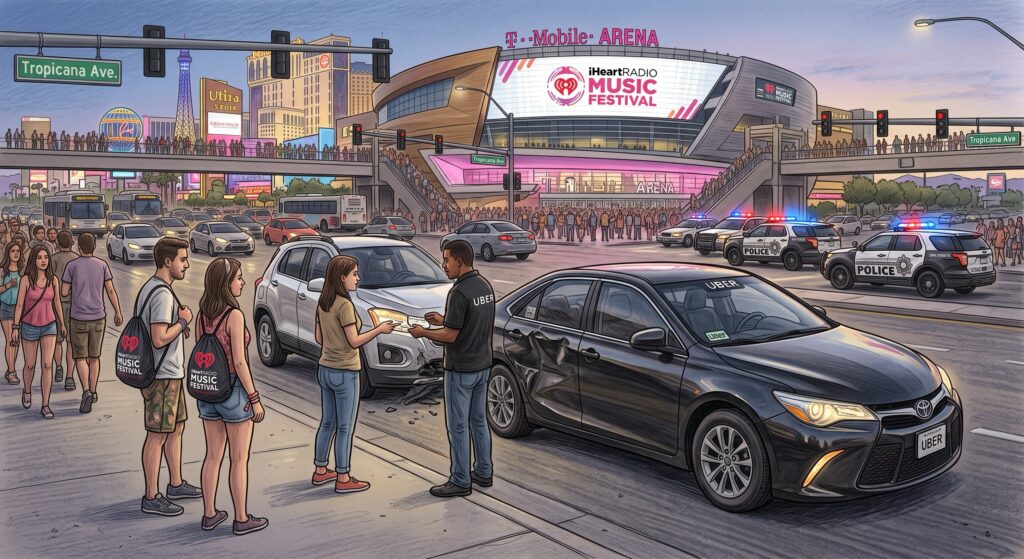
Every September, tens of thousands of music fans descend on T-Mobile Arena for the iHeartRadio Music Festival, turning the South Strip into one of the most congested rideshare corridors in the country for an entire weekend. Surge pricing spikes and drivers work back-to-back shifts to cash in on the crowd. Unfortunately, the combination of fatigued drivers, impossible GPS routing, and passengers stepping into active lanes produces serious accidents. iHeart Festival Uber crashes leave victims navigating one of the most complex insurance frameworks in Nevada. A Las Vegas rideshare accidents lawyer from The Paul Powell Law Firm knows how to cut through it. With Paul Powell, you’ll get “More Lawyer. Less Fee.™”
Risks of iHeart Festival Uber Crashes
The geography around T-Mobile Arena during major festival weekends creates a rideshare environment unlike anything the corridor sees during a normal weekend. Park Avenue, Tropicana Avenue, and Las Vegas Boulevard funnel all outbound traffic through the same limited road network simultaneously. Rideshare pickup zones that function adequately during standard events get overwhelmed when the iHeartRadio festival empties 20,000 people into the street at once, and drivers competing for position in those zones make the lane changes and sudden stops that cause rear-end and sideswipe collisions.
Guests staying at nearby properties like MGM Grand and New York-New York Hotel & Casino rely heavily on rideshare for the short hop between their hotels and the arena entrance. That last-mile rideshare traffic compounds the pedestrian congestion at crosswalks along Las Vegas Boulevard South, where iHeart Festival Uber crashes involving pedestrians are a documented risk every September.
Crash injuries in this corridor are rarely minor. The combination of pedestrian exposure, low-speed but high-mass vehicle conflicts in dense traffic, and occasional higher-speed impacts on Tropicana Avenue produces a range of outcomes from whiplash and broken bones to traumatic brain injuries.
In the most severe rideshare accidents, catastrophic injuries or wrongful death outcomes that require aggressive legal action against Uber’s commercial insurance carriers. The Paul Powell Law Firm has extensive experience representing families facing these difficult situations.
T-Mobile Arena Rideshare Accident in Las Vegas, NV
A T-Mobile Arena rideshare accident in Las Vegas, NV during a major music festival typically follows one of a few patterns: a driver pulling an illegal U-turn on Park Avenue to reach a passenger who pinned the wrong address, a rear-end collision in the backed-up Tropicana on-ramp queue when the driver ahead brakes for a pedestrian, or a sideswipe as two rideshare vehicles compete for the same gap in the pickup zone. All three are low-speed scenarios that can still produce serious injuries.
The T-Mobile Arena rideshare pickup area is one of the most documented collision zones in the Las Vegas Metropolitan Police Department’s event traffic reports. The Paul Powell Law Firm’s experienced injury attorneys handle iHeart Festival Uber crashes in this corridor regularly and know which camera systems cover the pickup zone, which businesses on Park Avenue have exterior cameras with useful sightlines, and how quickly those systems cycle off their footage after an event.
Traffic Surge on Tropicana and Las Vegas Blvd
Tropicana Avenue between Las Vegas Boulevard and Koval Lane is the primary egress route for festival attendees heading to Strip hotels north of the arena. During peak post-show traffic, that half-mile stretch carries thousands of vehicles simultaneously, many of them rideshare drivers who are running their GPS while also monitoring the app for new ride requests.
The combination of driver distraction and the stop-and-go nature of post-event gridlock produces rear-end collisions at rates that are measurably higher than the same stretch on a non-event night.
Pedestrian exposure on Las Vegas Boulevard at Tropicana is also severe during this window. Festival attendees jaywalking from the arena to the MGM Grand or Park MGM properties step into rideshare traffic that is moving faster than they expect because the vehicles have cleared the immediate arena congestion and are accelerating to beat the next signal cycle. A Las Vegas rideshare accidents lawyer from The Paul Powell Law Firm handles pedestrian accident claims on this specific stretch every major event weekend.
Causes of iHeart Festival Uber Crashes
Most iHeart Festival Uber crashes trace back to behaviors that the rideshare model itself incentivizes during high-demand events. Surge pricing creates financial pressure to complete as many trips as possible within the event window, which means drivers accept back-to-back rides without adequate breaks and make faster, more aggressive driving decisions than they would on a standard shift. The result is a driver who is fatigued, distracted by the app, and operating under time pressure in one of the most complex traffic environments in Nevada.
App distraction deserves specific attention. Uber and Lyft drivers must interact with their phones to accept rides, confirm passenger pickup, and navigate to destinations. In a dense event traffic environment where conditions change every few seconds, that phone interaction is happening simultaneously with lane changes and gap judgment decisions that require full visual attention. The NHTSA considers any manual phone interaction a critical distraction, and in festival traffic that distraction frequently translates into a failure to brake in time or a drift into an adjacent lane.
September Music Festival Uber Collision in Clark County, NV
A September music festival Uber collision in Clark County, NV carries the same insurance complexity as any other Uber crash, but the event context adds evidentiary opportunities that standard crashes lack. Uber’s internal trip logs document every second of the driver’s activity during the festival period, including whether they were on a trip, between trips, or waiting for a request at the moment of impact. That data, combined with LVMPD event traffic reports and arena corridor surveillance footage, can reconstruct the crash sequence with a precision that benefits the injured party.
Distracted Lyft Driver Crash in Nevada
A distracted Lyft driver crash in Nevada follows the same legal framework as an Uber crash. Lyft operates under an identical tiered insurance structure, and the same preservation demands apply to Lyft’s internal trip data.
The key distinction between Lyft and Uber claims is that Lyft’s driver documentation and screening practices differ, which can support a negligent hiring or retention argument in cases where the driver had a prior crash history that should have triggered deactivation. A Las Vegas rideshare accidents lawyer from The Paul Powell Law Firm evaluates the driver’s record as part of every rideshare injury case, regardless of which platform was involved.
Injuries in iHeart Festival Uber Crashes
The injury profile of an iHeart Festival Uber crash depends on the collision type and whether the victim was a passenger, a pedestrian, or the occupant of another vehicle. Passengers in rideshare vehicles during rear-end impacts suffer whiplash and soft tissue injuries at the highest rate, even at low speeds, because they are typically seated without awareness of the impending impact and cannot brace against it. Pedestrians struck by rideshare vehicles face the most severe outcomes, with traumatic brain injuries, multiple bone fractures, and in serious cases, spinal cord damage that produces permanent disability.
Medical evaluation immediately after any festival rideshare crash is essential. Adrenaline and alcohol, both common in a festival environment, mask pain effectively in the hours following an injury. Soft tissue damage, traumatic brain injury symptoms, and spinal instability can all present as minor discomfort initially and worsen significantly over the following 24 to 72 hours. A gap in medical documentation from the day of the crash weakens every subsequent aspect of the injury claim, and Uber’s adjusters are trained to exploit that gap.
Navigating Nevada Rideshare Insurance Laws
Nevada law requires rideshare companies operating in the state to maintain tiered insurance coverage that varies based on the driver’s app status at the moment of the crash. When the driver’s app is off, only their personal auto policy applies, and most personal policies include commercial activity exclusions that can leave the injured party with no meaningful coverage.
When the app is open but no trip has been accepted, Uber and Lyft provide contingent coverage up to $50,000 per person. When the driver has accepted a trip or is actively transporting a passenger, Nevada law’s minimum of $1.5 million in liability coverage will be in effect.
During a major event like the iHeartRadio festival, virtually every active rideshare driver in the arena corridor is in Phase 2 or Phase 3 at any given moment, which means the $1.5 million policy is almost always in play. That is significant because it changes the entire settlement dynamic compared to a crash involving a driver who was between fares. Establishing the correct phase through Uber’s internal trip data is one of the first actions a Las Vegas rideshare accidents lawyer from The Paul Powell Law Firm takes after being retained.
How App Status Impacts Your Liability Claim
The app status determination is not always straightforward. Uber’s internal records show the driver’s logged status at one-second intervals, but those records are subject to retention limits and can be lost if a preservation demand is not issued quickly. The rideshare company’s own claims adjusters have access to those records immediately after a crash and will use them to argue for the lowest applicable coverage tier.
Our Las Vegas injury attorneys request the same records through formal discovery and obtain an independent analysis of the GPS data that prevents the adjuster’s characterization of the coverage tier from going unchallenged.
Evidence for iHeart Festival Uber Crashes
The evidentiary window in iHeart Festival Uber crashes is short. T-Mobile Arena’s exterior cameras, the resort corridor cameras along Las Vegas Boulevard South, and NDOT traffic cameras on Tropicana Avenue all operate on rolling overwrite schedules. Uber’s internal trip data has its own retention limits. Witness accounts from festival attendees are difficult to collect after the fact because those witnesses may live anywhere in the country and leave Las Vegas the morning after the event.
The Paul Powell Law Firm sends preservation demands to the arena, the surrounding resorts, and Uber on the same day we are retained. We also work with LVMPD to obtain the responding officers’ crash report and any citations issued at the scene, which establish the preliminary fault determination that the insurance negotiation begins from. In cases where the driver’s GPS data shows a phone interaction in the seconds before impact, that data becomes central to the distraction argument.
Damages for iHeart Festival Uber Crashes
Recoverable damages in iHeart Festival Uber crashes include medical expenses from emergency treatment through projected future care, lost wages during recovery, reduced earning capacity for injuries that produce permanent limitations, pain and suffering, and disfigurement. When a crash produces catastrophic injuries or wrongful death, the damages calculation extends to lifetime care costs and survivor economic losses that can reach into seven figures.
The Paul Powell Law Firm has recovered more than $500 million for our clients and pushes for the maximum compensation available under Nevada law in every rideshare injury case. Our attorneys do not accept first offers from Uber’s insurance carriers, which are almost always calibrated to close claims before the full extent of injuries is established.
Why Use a Lawyer When Seeking Compensation for an Uber Accident in Nevada?
Seeking compensation for an Uber accident in Nevada without an attorney means negotiating against a claims team that handles hundreds of rideshare injury cases every year. Their adjusters know which arguments reduce payouts, which coverage tier characterizations go unchallenged, and how long they can delay before a claimant without legal representation gives up and accepts a low settlement. Our dedicated Las Vegas injury attorneys change that dynamic entirely. The moment legal counsel is involved, Uber’s team knows the claim will be contested through every available channel if they do not negotiate in good faith.
Call a Trusted iHeart Festival Uber Crashes Lawyer
Uber’s insurance team is working on your claim from the moment the crash is reported. A Las Vegas rideshare accidents lawyer from The Paul Powell Law Firm gets ahead of that process, securing trip data, camera footage, and witness information before they disappear. Our firm works on a no-win, no-fee basis, so there is no financial risk to calling today. Our Las Vegas injury attorneys handle rideshare, pedestrian, and all personal injury claims throughout Clark County.
The Paul Powell Law Firm is available 24/7 by phone. If you prefer online contact, you can connect with our LiveChat representatives or submit your free consultation request through our secure contact form. Great Results. Lightning Fast.™
The information on this blog is for general information purposes only. Nothing herein should be taken as legal advice for any individual case or situation. This information is not intended to create, and receipt or viewing does not constitute, an attorney-client relationship.