
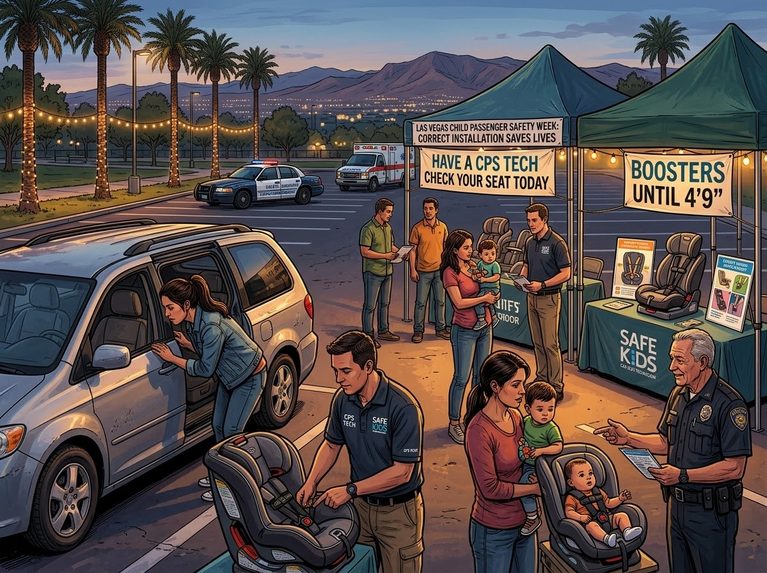
Mid-to-late September is an important time for families across Las Vegas to focus on child passenger safety as National Child Passenger Safety Week highlights the importance of properly securing young passengers. At the same time, the return to school can make roads around Clark County School District campuses, daycares, and busy commuter routes especially congested. Parents traveling along roads such as Blue Diamond Road, Summerlin Parkway, and Eastern Avenue may encounter sudden stops, distracted drivers, and crowded intersections. After Child Passenger Safety Week crashes, children can suffer devastating injuries despite being properly restrained. If your child was injured in a collision, a Las Vegas car accident lawyer can help your family understand its legal options. Contact The Paul Powell Law Firm to discuss your accident and potential claim.
Why Child Passenger Safety Week Matters in Las Vegas
Car crashes remain a significant danger for children riding in passenger vehicles. Properly installed car seats, booster seats, and seat belts can provide critical protection, but restraints cannot eliminate the risk created by a severe back-to-school collision in Las Vegas, NV.
National Child Passenger Safety Week is intended to remind parents and caregivers to make sure children are riding in an age- and size-appropriate restraint and that the restraint is installed correctly. The National Highway Traffic Safety Administration (NHTSA) recommends following both the child restraint manufacturer’s instructions and the vehicle owner’s manual when installing a car seat or booster seat.
This message is particularly relevant during the back-to-school season. Families may be making multiple daily trips between homes, schools, daycares, after-school activities, sports practices, and other destinations. More vehicles on the road can mean more opportunities for dangerous driving behavior.
Common Las Vegas School Zone Crashes
Traffic around schools and daycares can become unpredictable, particularly during morning drop-off and afternoon pickup. Drivers may be focused on finding a parking space, watching for children crossing the street, or attempting to move through congested traffic.
Common crashes can include:
- Rear-end collisions caused by following too closely
- Intersection crashes caused by failing to yield
- T-bone collisions caused by running red lights or stop signs
- Pedestrian accidents near school crossings
- Sideswipe collisions during lane changes
- Crashes caused by speeding through school zones
- Multi-vehicle accidents caused by sudden traffic backups
Even a Las Vegas school zone car crash in Nevada that appears relatively minor can cause significant injuries to a young passenger. Children have different physical vulnerabilities than adults, and the consequences of a collision may not always be immediately obvious.
Child Passenger Safety Week Crashes: Risks
Parents traveling with children on major Las Vegas-area roads may face especially challenging conditions during peak commuting hours. Blue Diamond Road can carry heavy traffic between residential areas and commercial destinations, while Summerlin Parkway connects busy neighborhoods and major routes on the city’s west side. Eastern Avenue also serves as an important north-south corridor.
When traffic becomes congested, a single distracted or aggressive driver can cause a chain reaction. A motorist looking at a phone, speeding to make a light, or following too closely may have little time to react when traffic stops.
A child’s injuries may include broken bones, internal injuries, spinal cord damage, traumatic brain injuries, or other serious trauma. In severe cases, an injury can require extensive rehabilitation and long-term care.
Nevada Child Passenger Restraint Laws
Nevada law establishes specific requirements for transporting children in motor vehicles. Under NRS 484B.157, a child who is less than 6 years old and less than 57 inches tall generally must be secured in an approved child restraint system appropriate for the child’s size and weight. The restraint must be installed safely according to the manufacturer’s instructions or a method approved by NHTSA.
Nevada law requires children under 2 years old to ride in a rear-facing child restraint in the back seat, subject to specific exceptions.
These requirements are important for parents to understand, but an important distinction exists in personal injury cases. Nevada’s child restraint statute specifically states that a violation of the restraint requirements may not be considered negligence in a civil action.
That means the circumstances surrounding a child’s injuries still need to be carefully investigated rather than assuming that a restraint issue determines who was responsible for a crash.
When a Car Seat Is Involved in a Crash
Parents sometimes assume that a car seat can simply continue being used after a collision if it does not appear damaged. That may not be the case.
NHTSA recommends replacing a car seat after a moderate or severe crash. The agency identifies several factors when determining whether a crash was minor, including whether the vehicle could be driven away, whether the door nearest the car seat was damaged, whether anyone was injured, whether airbags deployed, and whether there is visible damage to the car seat.
Families should also follow the specific manufacturer’s instructions regarding replacement after a crash.
If a child restraint appears to have malfunctioned, detached, broken, or otherwise failed during a collision, preserving the seat may be important. Instead of throwing it away, parents should consider discussing the situation with an attorney who can determine whether additional investigation is appropriate.
Investigating Defective Car Seats After a Crash
Most child passenger safety claims following a Clark County child injury car accident will focus on the conduct of the drivers involved. However, there may be situations where a defective or improperly functioning child restraint contributed to a child’s injuries.
Potential issues could include a defective buckle, harness failure, structural failure, faulty components, or other problems involving the design or manufacture of a restraint.
These cases can require specialized investigation. An attorney may need to examine the specific car seat model, manufacturing information, instructions, crash circumstances, photographs, medical records, and other evidence to determine whether a product defect may have played a role.
Parents should preserve the car seat and related materials whenever possible if there is a concern that the restraint itself failed.
What to Do after a Child Is Injured in a Crash
The health and safety of the child should always come first. After a collision, seek appropriate medical attention even when the child’s injuries do not initially appear severe. Some injuries can become more apparent hours or days after a crash.
Parents should also consider taking photographs of the vehicles, accident scene, traffic signals, road conditions, and visible injuries when it is safe to do so. Keep copies of medical records and bills, and document appointments, rehabilitation, medications, and other expenses associated with the child’s recovery.
If another driver caused the collision, their insurance company may contact the family. Parents should be cautious about providing recorded statements or accepting a settlement before understanding the extent of the child’s injuries and future needs.
Compensation for Child Passenger Safety Week Crashes
A serious injury can affect an entire family. Parents may face emergency medical bills, hospital stays, specialist appointments, physical therapy, medication costs, and other expenses. Severe injuries can also create long-term care needs that are difficult to calculate immediately after a crash.
Depending on the circumstances, a personal injury claim may seek compensation for medical expenses and other losses associated with the child’s injuries. When an injury leads to permanent impairment or ongoing treatment, it becomes particularly important to determine the potential long-term costs.
An attorney can investigate how the collision happened, identify potentially responsible parties, review insurance coverage, gather evidence, and negotiate with insurers on the family’s behalf.
Why Prompt Investigation Matters
Evidence can disappear quickly after a collision. Vehicles may be repaired or sold, surveillance footage may be overwritten, witnesses may become difficult to locate, and physical evidence may be altered.
This can be especially important when a child’s injury involves questions about the vehicle, a child restraint system, or another potentially defective product. Preserving evidence early can give investigators a better opportunity to determine what happened.
Families should also avoid discarding damaged car seats or other potentially relevant equipment before determining whether it could be important to the case.
Seeking Compensation for a Car Accident in Nevada
A child should never have to bear the consequences of another driver’s careless decision behind the wheel. While Child Passenger Safety Week provides an important reminder about proper restraints, even the best safety practices cannot always prevent serious injuries when another vehicle crashes into a family car.
If your child was injured in a Las Vegas school zone, daycare-area collision, or other Clark County car accident, determining what caused the crash is an important first step. Depending on the circumstances, that may involve examining driver behavior, roadway conditions, vehicle evidence, witness accounts, insurance coverage, and the performance of a child restraint.
The Paul Powell Law Firm can help families investigate these issues and pursue the compensation available under Nevada law.
Contact The Paul Powell Law Firm Now
A serious child passenger injury can leave parents facing uncertainty about their child’s recovery, medical needs, and future. If your child was hurt because another driver caused a crash in Las Vegas, you may have legal options for pursuing compensation.
Call, fill out a contact form, or use LiveChat to contact The Paul Powell Law Firm today to discuss your child’s accident, learn more about your rights, and determine what steps may be appropriate for your family. Great Results. Lightning Fast.™
The information on this blog is for general information purposes only. Nothing herein should be taken as legal advice for any individual case or situation. This information is not intended to create, and receipt or viewing does not constitute, an attorney-client relationship.