
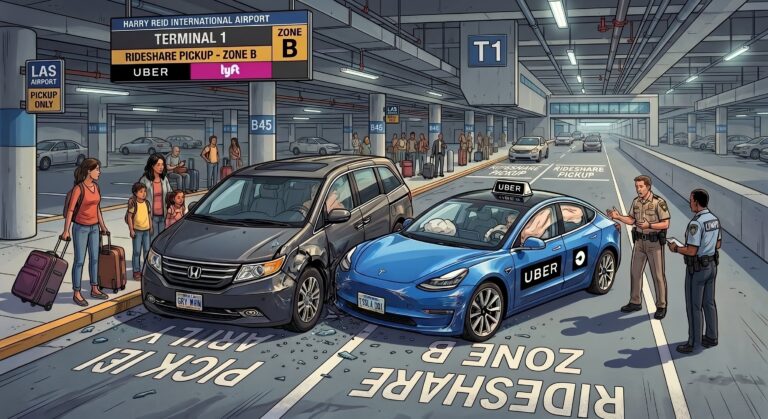
Few places in Las Vegas generate more vehicle conflict in less space than the rideshare pickup zones at Harry Reid International Airport (LAS). Drivers circling for position, passengers darting between lanes with luggage, and Uber contractors racing to clear one fare and grab the next create a pressure cooker where a Harry Reid Airport rideshare crash can happen in seconds. Unfortunately, accidents involving rideshare vehicles can be considerably more complex than a typical Las Vegas car accident.
This complexity is why you need an experienced Las Vegas Uber accident lawyer from The Paul Powell Law Firm. Our team understands how rideshare companies hide behind layers of insurance to limit your settlement. We stand ready to fight for every dollar you are owed, and remember that with Paul Powell, you get “More Lawyer. Less Fee.™”
The Risk of a Harry Reid Airport Rideshare Crash
Harry Reid International Airport handles over 50 million passengers per year, and a significant portion of those travelers rely on rideshare services to reach the Strip, downtown, or the suburbs. That volume concentrates an enormous number of Uber and Lyft vehicles into a compact ground transportation corridor where lanes are tight, signage is dense, and driver attention is constantly divided between the app, the GPS, and the surrounding traffic. A Harry Reid Airport rideshare crash in this environment often involves rear-end impacts, sideswipes during lane changes, and pedestrian strikes at crosswalks where rolling stops are common.
Injuries from these crashes range widely in severity. Passengers seated in the back of a rideshare vehicle when impact occurs frequently suffer whiplash and soft tissue injuries to the neck and shoulders even at low speeds. Higher-speed collisions in the airport access roads produce broken bones, traumatic brain injuries from head strikes against door frames or headrests, and in serious cases, catastrophic spinal trauma that requires extended hospitalization. Bystanders and pedestrians caught in the crosswalk zones near Terminal 1 face the most severe outcomes when a driver fails to yield.
Travelers heading to properties on the Strip such as Caesars Palace, the Bellagio, or Resorts World Las Vegas represent the bulk of the rideshare demand flowing out of the airport. The urgency those drivers feel to complete fares quickly and cycle back for the next pickup contributes directly to the aggressive lane behavior that causes so many auto accidents in the pickup zones.
Dangers of an LAS Terminal 1 Uber Accident
Terminal 1 at Harry Reid handles the majority of domestic arrivals, and its Zero Level rideshare staging area is the most congested vehicle zone at the entire airport. A LAS Terminal 1 Uber accident typically involves one of three scenarios: a driver rear-ending the vehicle ahead while watching the app for passenger confirmation, a sideswipe collision during the aggressive jockeying for curb position, or a pedestrian strike when a driver pulls forward without checking the crosswalk. All three happen with enough regularity that airport security personnel are stationed at the zone specifically to manage vehicle flow.
What makes a LAS Terminal 1 automobile wreck legally complex is the presence of multiple potential defendants. The Uber driver is the most obvious party, but the rideshare company itself, the airport authority, and in some cases the driver of another vehicle who triggered a chain reaction may all share liability.
Sorting through those relationships quickly, before evidence from airport security cameras is overwritten, is where the experience of a Las Vegas Uber accident lawyer from The Paul Powell Law Firm makes a real difference.
Harry Reid Airport Rideshare Crash Insurance
The insurance picture in a Harry Reid Airport rideshare crash is more complicated than in a standard car crash between two private drivers. Uber operates under a tiered coverage system that assigns different policy limits depending on what the driver was doing at the exact moment of impact. That single variable, which phase of the trip the driver was in, can be the difference between a $50,000 policy limit and a $1 million commercial policy, so establishing it precisely is one of the first things your attorney needs to do.
Nevada law requires rideshare companies operating within the state to maintain minimum coverage thresholds at each tier, but the practical challenge is that Uber’s own claims adjusters are trained to push the lowest applicable tier as aggressively as possible. Without an knowledgeable injury attorney who understands the NV Uber passenger injury claim process, many victims accept settlements that fall far short of what their injuries actually cost.
Rideshare Insurance Tiers in Nevada
Rideshare insurance tiers in Nevada break down into three phases. In Phase 1, the driver has the app open but has not accepted a ride request. During this window, Uber provides contingent liability coverage of up to $50,000 per person and $100,000 per accident, supplementing the driver’s personal policy if it does not cover commercial activity.
In Phase 2, the driver has accepted a request and is en route to pick up the passenger. Phase 3 begins when the passenger enters the vehicle. During both Phase 2 and Phase 3, Uber’s full $1 million commercial liability policy is in effect.
The coverage gap that injures most victims financially is Phase 1. When a driver causes a car crash while waiting for a fare, the $50,000 ceiling can be exhausted quickly by a single hospitalization. If the driver’s personal insurer also denies the claim on commercial activity exclusion grounds, the injured party faces a coverage shortfall that only an experienced attorney can navigate effectively through uninsured or underinsured motorist claims or direct action against Uber.
Proving a Harry Reid Airport Rideshare Crash
The evidentiary foundation of a Harry Reid Airport rideshare crash claim is stronger than most victims realize when they walk out of the emergency room. The airport’s security camera network covers the entire ground transportation level, the access roads, and the crosswalk zones.
Uber’s own trip data logs, accessible through legal discovery, record GPS coordinates, timestamps, and trip status at one-second intervals. Combined with the police report, witness statements from other travelers, and medical records documenting the full range of injuries, that evidence package can paint a precise picture of exactly what happened and who bears responsibility.
The critical window is the first 48 to 72 hours. Airport security systems cycle footage on rolling overwrite schedules, and Uber’s internal data is subject to the same retention limits as any commercial operator. A preservation demand issued by an attorney immediately after the crash can lock all of that material in place. The Paul Powell Law Firm treats evidence preservation as the top priority on day one of every rideshare case because the strongest claims are the ones built on complete records, not reconstructed from fragments.
Be sure not to sign anything or accept a settlement until your medical treatment is complete. Settling too early means waiving your right to compensation for injuries that surface weeks or months down the road, and once you sign, there’s no going back. An experienced injury attorney will ensure you have a full picture of your injuries before you agree to anything final.
How a Las Vegas Uber Accident Lawyer Helps
A Vegas rideshare injury attorney builds the case from the ground up: pulling trip data, issuing camera preservation demands, interviewing witnesses at the scene, and engaging accident reconstruction professionals when the collision dynamics are disputed. Beyond evidence gathering, the attorney’s role is to keep the insurance process honest.
Uber’s claims team moves fast after a crash, and their first goal is to establish the lowest possible coverage tier before you have had a chance to consult counsel. A Las Vegas Uber accident lawyer from The Paul Powell Law Firm intercepts that process and ensures the correct tier is applied from the start.
For passengers heading to Henderson neighborhoods near the Water Street District or visitors catching a rideshare to Downtown Container Park, the same legal framework applies whether the crash happened in the airport pickup zone or on the highway between the terminal and the destination. No matter the specific situation, The Paul Powell Law Firm understands how to handle rideshare injury claims across all of Clark County.
Harry Reid Airport Rideshare Crash FAQ
A Las Vegas Uber accident lawyer from The Paul Powell Law Firm handles rideshare injury claims throughout Clark County every day. Here are answers to the questions we hear most often from clients hurt in and around Harry Reid International Airport.
Who pays my NV Uber passenger injury claim?
If you were a passenger in the Uber vehicle when the crash occurred, Uber’s $1 million Phase 3 commercial policy is the primary source of compensation. That policy covers medical expenses, lost wages, pain and suffering, and other damages regardless of whether the Uber driver or another driver was at fault. If a third-party driver caused the collision, your attorney can pursue both Uber’s uninsured motorist coverage and the at-fault driver’s personal liability policy simultaneously.
Who is at fault in a Harry Reid Airport rideshare crash?
Fault follows Nevada’s modified comparative negligence standard. Any driver whose negligence contributed to the crash can be held liable for their proportionate share of damages, including the Uber driver, other vehicle operators, and in some cases the airport authority if a road design defect or inadequate signage contributed to the collision. Your attorney investigates all potential defendants before filing to ensure no responsible party escapes the claim.
Does Uber pay if my driver was just en route?
Yes. Once a driver has accepted a ride request and is en route to the pickup location, Uber’s full $1 million Phase 2 commercial policy is active. If you are the passenger who was waiting to be picked up and were struck as a pedestrian in the Terminal 1 zone while your driver was approaching, that Phase 2 coverage applies to your injuries. The exact trip status at the moment of impact is confirmed through Uber’s internal data logs.
What if a taxi causes a Harry Reid Airport rideshare crash?
If a taxi or other vehicle strikes your Uber during the airport crash, the at-fault driver’s commercial auto policy is the primary source of recovery. Nevada taxis operating under a franchise with the Nevada Transportation Authority (NTA) are required to carry commercial liability coverage. If that driver is underinsured, Uber’s underinsured motorist coverage may bridge the gap. Your attorney files against every available policy to prevent coverage shortfalls from leaving your medical bills unpaid.
How long do I have to file a Nevada injury claim?
Nevada Revised Statutes 11.190 gives most personal injury claimants two years from the date of the auto accident to file suit. Claims against government entities, such as the Clark County airport authority, may require a notice of claim within 90 days. Airport security footage and Uber trip data disappear well before the two-year mark, so contacting an attorney as quickly as possible after a Harry Reid Airport rideshare crash is essential.
Call a Harry Reid Airport Rideshare Crash Attorney
Uber’s insurance team is experienced, well-funded, and motivated to minimize what you collect. You deserve a Las Vegas injury attorney that matches that firepower and knows this process inside out. The Paul Powell Law Firm has recovered more than $500 million for injured Nevada clients over 25 years of practice, and our firm works on a no-win, no-fee basis so there is no financial risk to calling today.
The Paul Powell Law Firm is available 24/7 by phone at (702) 728-5500. If you prefer to reach out through the Internet, you can speak with our online LiveChat representatives or submit your free consultation request through our secure contact form. Great Results. Lightning Fast.
The information on this blog is for general information purposes only. Nothing herein should be taken as legal advice for any individual case or situation. This information is not intended to create, and receipt or viewing does not constitute, an attorney-client relationship.