
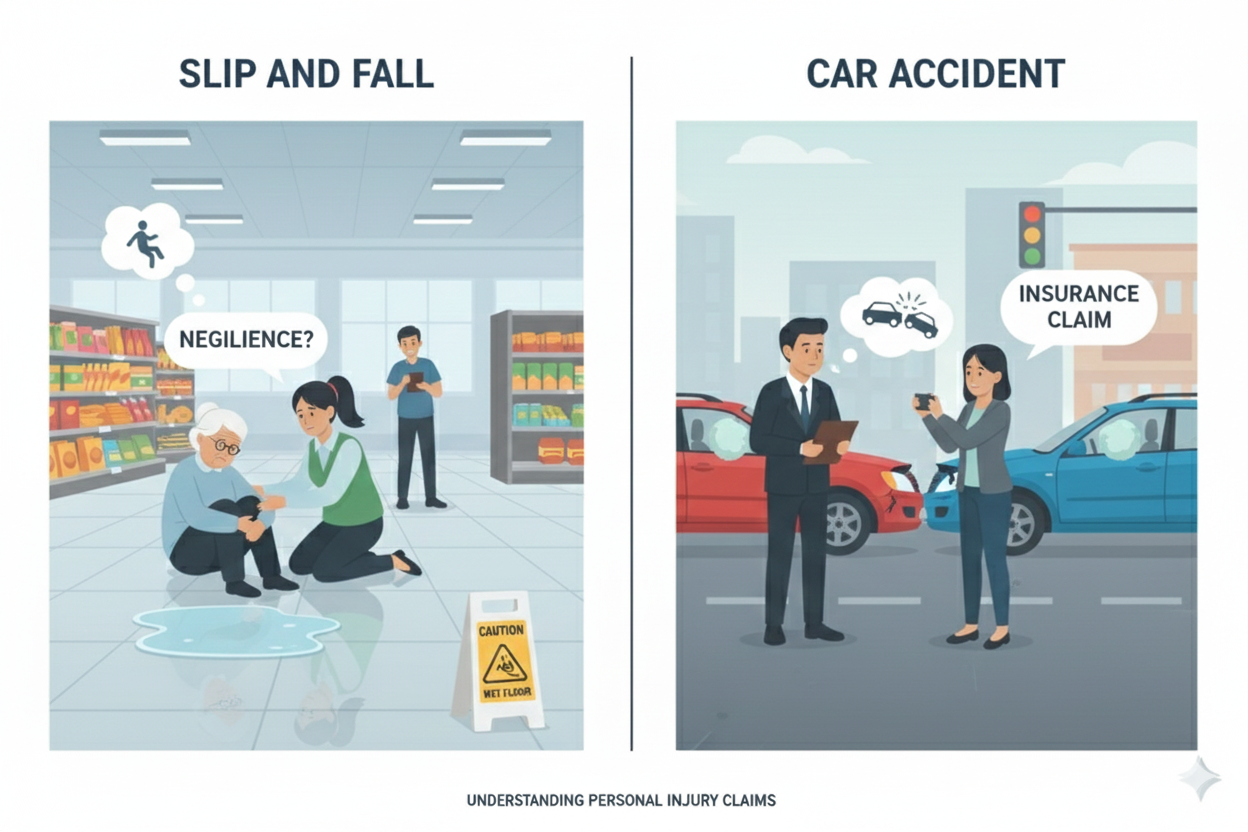
A slip and fall accident and a car accident may seem similar on the surface – they are both personal injury claims where a victim seeks compensation. But legally, they follow two very different paths. The strategy for proving fault, collecting evidence, and negotiating a fair settlement varies dramatically depending on what type of accident happened.
In both situations, victims may be entitled to compensation for:
- Economic damages: medical bills, lost income, rehabilitation costs
- Non-economic damages: pain and suffering, emotional distress, loss of enjoyment of life
This article breaks down the five biggest differences between slip and fall claims and car accident claims—and what victims in Las Vegas need to know to protect their case.
The Core Difference: Proving Liability
1. Car Accidents – A Negligence-Based System
Car accident cases typically revolve around proving driver negligence. This means showing that another driver’s careless actions directly caused the crash.
Common negligence factors include:
- Speeding
- Distracted driving (texting, eating, GPS use)
- Failing to yield
- Running a red light
- Following too closely
Key evidence in car accident claims includes:
- Police reports
- Traffic citations
- Photos of vehicle damage
- Eyewitness statements
- Dash cam footage
- Vehicle black-box data
The at-fault party is usually straightforward: the other driver, and their auto insurance company is responsible for damages.
2. Slip and Falls – A Premises Liability System
Slip and fall cases are governed by premises liability law, which is much more complex. To win, the injured person must prove the property owner or occupier:
- Knew or should have known about the hazardous condition, and
- Failed to repair it or warn visitors in a reasonable time
Examples of hazardous conditions include:
- A spill on a grocery store floor
- A broken handrail
- Loose carpeting
- Uneven concrete
- Poor lighting
Key evidence in slip and fall cases includes:
- Surveillance footage
- Incident reports
- Store maintenance logs
- Witness statements
- How long the hazard existed
- Photographs taken immediately after the fall
Here, the defendant could be a property owner, business owner, property manager, or even a maintenance contractor, and their commercial liability insurer is typically involved.
Key Difference #1: The Type of Insurance Policy Involved
Insurance policies play a huge role in determining compensation and strategy.
Car Accident Claims → Auto Liability Insurance
Auto liability insurance is designed specifically for traffic collisions. These cases typically involve:
- Clear policy limits
- A structured investigation process
- Adjusters who handle car accident claims daily
Car accident lawyers understand how to demand full compensation by analyzing vehicle damage, medical records, and police reports.
Slip and Fall Claims → Commercial Liability or Homeowner’s Insurance
Slip and fall cases involve commercial general liability (CGL) or homeowner’s insurance. Compared to auto insurers, these policies:
- Often disputes liability more aggressively
- Hire specialized investigators
- Issue lower initial settlement offers
- Require more documentation to prove fault
This difference alone makes slip and fall claims significantly more challenging.
Key Difference #2: The Role of Comparative Negligence
Nevada follows a modified comparative negligence rule (51% bar rule). Your compensation is reduced by your percentage of fault. If you’re more than 50% at fault, you cannot recover anything.
Both slip and fall and car accident claims use this rule—but the arguments are very different.
Car Accident Comparative Fault Strategies
Insurers may argue that the victim:
- Was speeding
- Failed to brake in time
- Followed too closely
- Didn’t have the headlights on
- Made an unsafe turn
These arguments are usually based on measurable evidence like skid marks, vehicle damage, or black-box data.
Slip and Fall Comparative Fault Strategies
In slip and fall cases, insurers almost always attack the victim’s conduct. Common defenses include:
- “The hazard was open and obvious.”
- “They were distracted by their phone.”
- “They were wearing inappropriate footwear.”
- “The victim wasn’t watching where they were walking.”
This makes it essential for victims to document their surroundings and actions immediately after the accident.
Consult a personal injury attorney today! Contact Us
Key Difference #3: Critical Evidence Collection
Car Accident Evidence → Automatically Documented
Car accidents have built-in evidence advantages:
- Police investigate the scene
- Vehicles show clear impact points
- Traffic cameras or dash cams often capture the collision
- Insurance companies document vehicle damage
The strategy is focused on preserving this evidence.
Slip and Fall Evidence → Easily Lost
Slip and fall hazards disappear quickly:
- Spills are mopped up
- Ice melts
- Broken flooring is repaired
- Warning signs are added after the incident
Because of this, the victim must take immediate action:
- Photograph the hazard
- Get witness contacts
- Report the incident to a manager
- Request that surveillance footage be preserved
Without this proof, the claim becomes much harder to win.
Key Difference #4: Difficulty Identifying the Liable Party
Car Accidents: Liability Is Clear
The responsible party is almost always known and listed in the police report. Drivers must provide their:
- License
- Insurance information
- Registration
Identifying the correct insurer is straightforward.
Slip and Falls: Liability Is Often Complicated
A slip and fall may involve several potential defendants:
- Property owner
- Business tenant
- Property management company
- Maintenance contractor
- Cleaning service
It may take significant investigation to determine who controlled the property at the time of the incident.
To maximize compensation, an attorney may need to file claims against multiple parties to access all available insurance coverage.
Key Difference #5: The Statute of Limitations
Both car accident and slip and fall cases are subject to Nevada’s Statute of Limitations, which dictates when a lawsuit must be filed.
But here’s the major difference:
- Car accident claims often progress faster because evidence is captured immediately.
- Slip and fall claims need extensive investigation because key evidence disappears quickly.
This means slip and fall victims must contact a lawyer sooner to preserve evidence before it becomes unavailable.
The Bottom Line on Slip & Fall vs. Car Accident Claims
Slip and fall and car accident claims may both involve medical bills, lost wages, and pain and suffering—but the legal strategies behind them are entirely different.
- Car accident claims rely on driver negligence, objective evidence, and auto insurance policies.
- Slip and fall claims rely on premises liability, fleeting evidence, and complex insurance arrangements.
Because of the higher complexity and the ease with which evidence disappears, hiring an attorney early is especially critical in slip and fall cases—but equally important in any serious car accident claim.
If you or a loved one has been injured, don’t navigate the system alone.
FAQ
1. What is the biggest difference between a slip and fall claim and a car accident claim?
The biggest difference is how liability is proven.
- Car accidents rely on proving driver negligence, such as speeding or distracted driving.
- Slip and falls rely on premises liability, which requires proving the property owner knew—or should have known—about a dangerous condition and failed to fix it.
Premises liability cases typically require more evidence and more investigation than most car accident claims.
2. Who is responsible in a slip and fall case?
Responsibility may fall on multiple parties, including:
- The property owner
- A business tenant
- The property management company
- Maintenance or cleaning contractors
Because several parties may share fault, identifying the correct defendant is often more complicated than in a car accident.
3. Why are slip and fall claims harder to prove than car accident claims?
Slip and fall hazards are often temporary—spills get cleaned, ice melts, and broken flooring may be repaired immediately after the incident.
Evidence disappears quickly, which makes proof more difficult.
Car accidents, on the other hand, typically have:
- A police report
- Photos of vehicle damage
- Skid marks or debris
- Witnesses at the scene
Slip and fall victims often bear a heavier burden to document the hazard right away.
4. What kind of evidence do I need for a slip and fall claim?
Essential evidence includes:
- Photos of the hazard
- Surveillance footage
- Incident reports
- Witness statements
- Maintenance or inspection logs
- Proof of how long the hazard existed
The more documentation available, the stronger your case becomes.
5. What evidence is most important in a car accident claim?
Car accident claims rely heavily on:
- Police reports
- Crash diagrams
- Traffic citations
- Vehicle damage photos
- Dash cam or traffic camera footage
- Black-box (ECM) data
- Medical records
Most of this information is recorded immediately, making car accident claims easier to substantiate.