
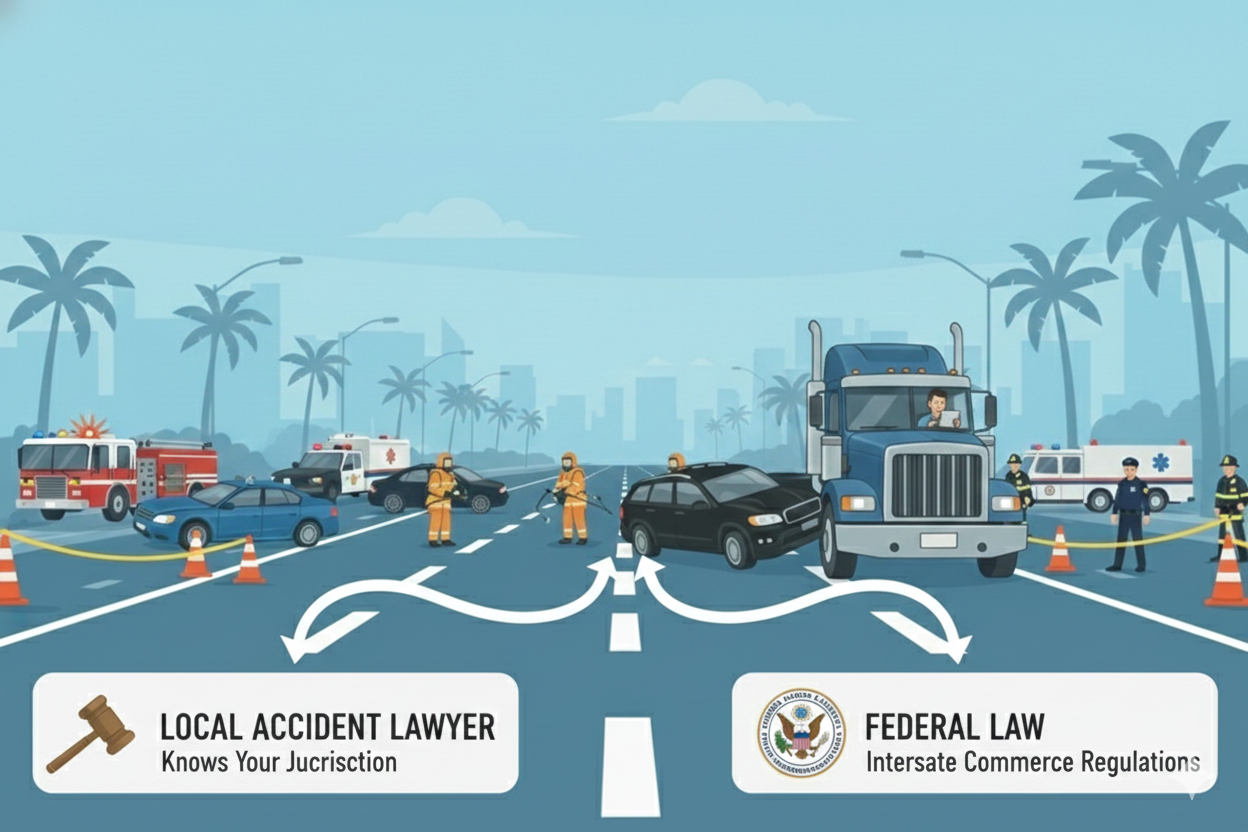
If you’ve been hurt in a crash with an 18-wheeler on I-15, the 215 Beltway, or US-95, you’re dealing with more than just painful injuries and car damage. You’re up against trucking companies and insurers that move fast to protect themselves. What many people don’t realize is this: federal trucking regulations were created to protect you – and when those rules are broken, they can significantly strengthen your injury claim.
Commercial trucks aren’t governed by the same rules as passenger cars. The Federal Motor Carrier Safety Administration (FMCSA) sets strict standards for how long drivers can be on the road, how trucks must be maintained, how cargo is secured, and even how drivers are tested for drugs and alcohol. When a company cuts corners, those violations can become powerful evidence of negligence.
Below are five key federal regulations that may play a major role in your case – and how a Las Vegas truck accident lawyer uses them to fight for fair compensation. With over $500 million recovered and 75+ million-dollar results, Paul Powell understands how to uncover these violations and put them to work for injured Nevadans.
Hours-of-Service (HOS) Rules Protect You from Fatigued Drivers
Truck driver fatigue is one of the leading causes of serious commercial vehicle crashes. That’s why FMCSA Hours-of-Service (HOS) rules strictly limit how long drivers can be behind the wheel.
In simple terms, drivers carrying property can drive a maximum of 11 hours after taking 10 consecutive hours off duty. They also cannot drive beyond the 14th consecutive hour after starting their workday – even if they took breaks. On a weekly level, drivers are limited to 60 hours in 7 days or 70 hours in 8 days, depending on their schedule.
Today, most commercial drivers must use Electronic Logging Devices (ELDs), which automatically record driving time. This digital data makes it much harder for companies to hide violations.
Why does this matter to you? Because a fatigued driver has slower reaction times, impaired judgment, and reduced awareness – similar to drunk driving. If records show a driver exceeded HOS limits before your crash, that can be strong evidence of negligence.
Vehicle Maintenance Requirements Can Reveal Negligence
Trucking companies must keep their vehicles in safe working condition. FMCSA regulations require systematic inspection, repair, and maintenance of all commercial trucks.
Drivers must perform pre-trip and post-trip inspections and note any safety problems. Carriers are responsible for ensuring critical systems – including brakes, tires, steering components, lights, and coupling devices – are properly maintained. They must also keep detailed maintenance records.
When a truck’s brakes fail on the Las Vegas Strip, or a tire blows out on the 215 Beltway, investigators look at whether required inspections were skipped or repairs delayed. Missing documentation, repeated unresolved defects, or ignored safety warnings can point directly to trucking company negligence.
Unlike a typical car accident, liability in truck crashes often extends beyond the driver. If poor maintenance played a role, the trucking company itself may be legally responsible for your injuries.
These maintenance records can become key pieces of evidence in proving the crash was preventable.
Drug and Alcohol Testing Rules: What Trucking Companies Must Do
Commercial drivers are held to stricter substance rules than everyday motorists. While the legal blood alcohol limit for most drivers is 0.08%, for commercial truck drivers it’s just 0.04%.
FMCSA regulations require trucking companies to conduct mandatory drug and alcohol testing in several situations:
- Pre-employment testing
- Random testing throughout employment
- Post-accident testing
- Testing based on reasonable suspicion
Companies must keep records of these tests and remove drivers who fail from safety-sensitive duties.
If a trucking company skips required tests or keeps a driver on the road after a positive result, that can support a claim of negligent hiring or retention. After a serious crash, post-accident test results can often be subpoenaed and used as evidence.
Even if drugs or alcohol aren’t involved in your specific case, a company’s failure to follow testing rules may show a broader pattern of ignoring safety regulations.
Weight Limits and Cargo Securement: When Overloaded Trucks Cause Crashes
A fully loaded semi-truck can weigh up to 80,000 pounds under federal law. That’s about 20 times heavier than a typical passenger car. Because of that danger, FMCSA regulations set strict weight limits and detailed cargo securement rules.
Overloaded trucks require longer stopping distances and put extra stress on brakes and tires. Improperly secured cargo can shift during turns, causing rollovers, jackknifes, or spilled loads across highways like I-15.
Responsibility for these violations doesn’t always fall on just the driver. The trucking company, shipping company, or loading crew may all share liability if they failed to follow federal cargo and weight rules.
In injury cases, attorneys often review weigh station records, bills of lading, and cargo loading procedures. Evidence that a truck was overweight or improperly loaded can be critical in showing the crash was preventable.
Insurance Requirements: Why Trucking Companies Carry More Coverage
Because truck crashes often cause catastrophic injuries, federal law requires trucking companies to carry much higher insurance limits than ordinary drivers.
For general freight, carriers must carry at least $750,000 in liability coverage. Trucks transporting oil must carry $1 million, and certain hazardous materials require $5 million in coverage.
Compare that to Nevada’s minimum car insurance requirements, which are far lower. This higher coverage can make a major difference when victims face long-term medical care, lost earning capacity, and permanent disabilities.
An experienced truck accident lawyer doesn’t just look at one policy. There may be multiple layers of insurance involving the driver, trucking company, trailer owner, or cargo company. Identifying every available policy is key to pursuing full compensation.
How a Truck Accident Lawyer Uses Federal Regulations to Build Your Case
Trucking companies often deploy rapid-response teams after serious crashes — sometimes within hours. Their goal is to protect the company, not you. Critical evidence like ELD data, driver logs, maintenance files, and drug testing records can disappear if action isn’t taken quickly.
A truck accident lawyer sends preservation letters, subpoenas records, and investigates whether FMCSA rules were violated. These cases are built on details, and federal regulations provide a framework for proving a company failed to operate safely.
Paul Powell’s firm has made uncovering regulatory violations a standard part of truck crash investigations, helping secure over $500 million for injury victims.
Nevada Truck Accident Laws: What Las Vegas Victims Need to Know
In Nevada, you generally have two years from the date of the crash to file a personal injury lawsuit (NRS 11.190). Property damage claims typically have a three-year limit. Waiting too long can mean losing your right to compensation entirely.
Nevada also follows a modified comparative negligence rule. You can recover damages as long as you are less than 50% at fault, but your compensation may be reduced by your percentage of responsibility.
Truck crashes are common along major freight routes like I-15, the 215 Beltway, and US-95. Cases often involve Nevada Highway Patrol investigations and proceedings in Clark County courts, making local experience especially valuable.
Injured in a Truck Accident? Call Paul Today.
A serious truck crash can turn your life upside down — physically, emotionally, and financially. You don’t have to face the trucking company and their insurers alone. The Paul Powell Law Firm has recovered over $500 million for injury victims and achieved 75+ million-dollar results while standing by the promise: “More Lawyer. Less Fee.”
We’re available 24/7 to listen to your story, answer your questions, and explain your options. You pay nothing unless your case is successful – and we never take more than you at the end of your case.
Time limits apply, and critical evidence can disappear quickly. Taking action today can help protect your rights and your future.
Frequently Asked Questions
How long do I have to file a truck accident lawsuit in Nevada?
In Nevada, you have 2 years from the accident date to file a personal injury lawsuit and 3 years for property damage. However, key evidence in truck accident cases—like electronic logging device data and maintenance records—can be lost quickly. Speaking with a truck accident lawyer early helps preserve critical evidence and protect your claim.
Who can be held liable in a truck accident case?
Liability may extend beyond the driver. The trucking company, vehicle manufacturer, cargo loader, or shipping company could also be responsible. Federal regulations place safety duties on carriers, and violations can point to company negligence. A thorough investigation identifies all potentially liable parties.
What compensation can I recover after a truck accident?
You may be able to recover medical expenses, future treatment costs, lost wages, reduced earning capacity, pain and suffering, and property damage. In cases involving especially reckless behavior, additional damages may be available. Truck accidents often cause severe injuries, which can significantly increase the value of a claim.
How do federal trucking regulations help my case?
FMCSA rules set safety standards for driver hours, maintenance, drug testing, and cargo loading. When a driver or company violates these rules, it can help establish negligence. These violations are often documented in records that attorneys can obtain and use as evidence.
How much does it cost to hire a truck accident lawyer?
The Paul Powell Law Firm works on a contingency fee basis, meaning you pay nothing unless your case is successful. The firm’s “More Lawyer. Less Fee.” promise means they never take more money than you at the end of your case. Call (702) 728-5500 for a free case evaluation available 24/7.