
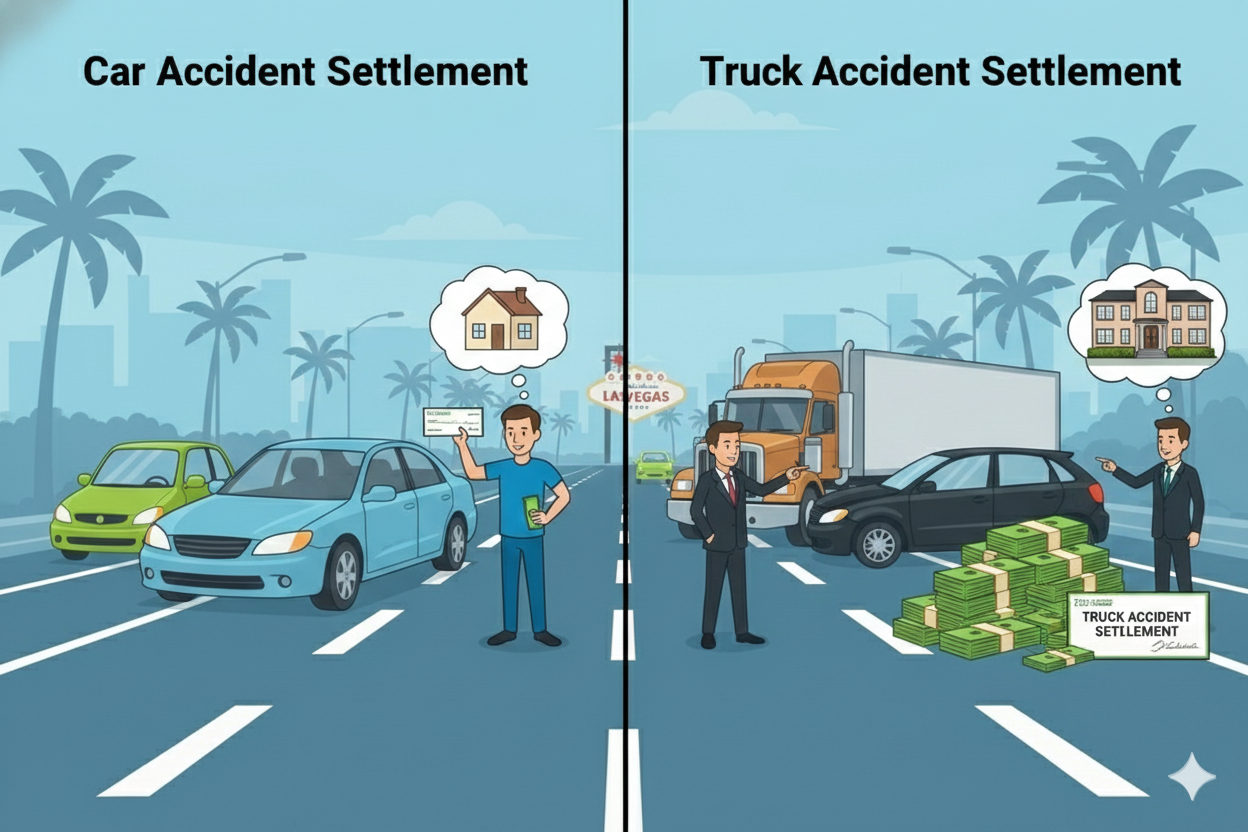
When a typical passenger car—usually weighing around 3,000 to 4,000 pounds—is involved in a crash, the force is significant. But when that same vehicle collides with a fully loaded semi-truck weighing up to 80,000 pounds, the consequences are devastating.
The difference in physical forces alone explains why truck accident cases in Nevada routinely result in larger settlements, more complex investigations, and far greater legal challenges compared to standard car accident settlements.
While both types of cases fall under Nevada’s fault-based personal injury system, the settlement process varies dramatically. Why? Because commercial trucking companies operate under strict federal rules, carry massive insurance policies, and involve multiple layers of corporate responsibility.
In this guide, you’ll learn the five key differences between truck accident and car accident settlements in Nevada—and why victims of truck crashes need a law firm with experience handling commercial vehicle cases.
1. Severity of Damages and Settlement Value
Car Accident Injuries
Most car accident injury settlements in Nevada involve:
- Whiplash or soft-tissue injuries
- Fractures
- Moderate vehicle damage
- Short-term medical treatment
- Claims are limited by the at-fault driver’s personal insurance
These cases are serious—but they rarely compare to the destruction seen in large truck collisions.
Truck Accident Injuries
Truck accidents often result in catastrophic harm, such as:
- Traumatic brain injuries (TBI)
- Spinal cord damage and paralysis
- Severe burns
- Multiple fractures
- Organ damage
- Wrongful death
Nevada Impact
Because the injuries are more severe, victims often require:
- Lifetime medical care
- Long-term rehabilitation
- In-home nursing
- Mobility assistance devices
- Permanent home modifications
This significantly increases the value of a truck accident settlement. It’s not uncommon for truck accident claims to reach hundreds of thousands—or even millions—of dollars due to the extensive damage.
2. Insurance Policy Limits and Coverage (The Payout Potential)
Car Accident Insurance in Nevada
Nevada’s minimum liability limits are:
- $25,000 per person
- $50,000 per accident for bodily injury
In serious crashes, these limits are quickly exhausted, leaving victims with little compensation unless the driver carries additional coverage.
Truck Accident Insurance Requirements
Commercial trucks operating across state lines must follow federal rules. Under the Federal Motor Carrier Safety Administration (FMCSA), truck companies are required to carry:
- $750,000 to $1 million minimum liability insurance
- Up to $5 million for hazardous materials
Nevada Impact
The difference in available insurance coverage is dramatic. With truck accidents:
- There is more money available for victims to recover full compensation.
- Settlement amounts reflect long-term needs, not just immediate medical bills.
- Victims have a better chance of securing compensation for catastrophic injuries, loss of income, and future care.
3. Multiple Liable Parties (Who You Can Sue)
Car Accident Liability
In a typical car wreck settlement, liability usually involves:
- The at-fault driver
- Possibly their employer (if on the job)
The process is simpler and usually involves just one insurance carrier.
Truck Accident Liability
Truck accident cases often include multiple potential defendants, such as:
- The truck driver
- The trucking company or motor carrier
- A third-party cargo loading company
- A maintenance contractor
- A truck or parts manufacturer
- A freight broker
- A shipping company
Nevada Impact
Why does this matter? Because:
- More defendants = more available insurance
- More parties = higher settlement potential
- More complexity = greater need for an experienced truck accident law firm
Every defendant may share responsibility, which allows victims to pursue compensation from multiple sources.
Searching for law services? Free Case Evaluation
4. Governing Regulations and Standard of Care
Car Accidents in Nevada
Standard car accident claims rely on:
- Nevada traffic laws
- Rules of the road under NRS statutes
- Basic negligence principles
Truck Accidents Are Different
Truck drivers and trucking companies must comply with strict FMCSA regulations, including:
- Hours-of-Service limits to prevent fatigue
- Mandatory drug and alcohol testing
- Vehicle maintenance and inspection requirements
- Weight and cargo securement rules
- Driver qualification standards
Nevada Impact
If a truck driver or trucking company violates FMCSA regulations, it may constitute negligence per se—meaning fault can be automatically established.
This makes truck accident claims:
- Stronger
- More valuable
- More favorable for victims who can prove regulatory violations
Truck drivers are held to a higher standard of care, and Nevada courts recognize the significance of these federal rules.
5. Evidence Collection and Preservation
Car Accident Evidence
Car accident injury settlements typically rely on:
- Police reports
- Photos of the crash
- Witness statements
- Medical records
Important evidence, but not nearly as complex.
Truck Accident Evidence
Truck accidents require immediate and highly specialized investigation. Key evidence includes:
- Electronic Logging Device (ELD) data
- Truck “black box” information (speed, braking, engine data)
- Driver qualification and training files
- Hours-of-service compliance logs
- Maintenance and inspection records
- Cargo loading documentation
- Drug/alcohol test results
- Company safety history
This evidence can disappear quickly unless preserved immediately—often within days.
Nevada Impact
Without proper evidence, a victim may lose the ability to prove negligence.
Top truck accident attorneys know how to:
- Send preservation letters
- Secure black-box data
- Work with accident reconstruction specialists
- Analyze FMCSA violations
- Build a case for maximum settlement value
Protect Your Rights After a Truck Accident
While both car and truck accident claims fall under personal injury law, truck accident settlements in Nevada are fundamentally different. From higher insurance coverage and catastrophic injuries to complex regulations and multiple liable parties, these cases require a specialized legal approach.
Key Takeaways:
- Truck accidents often involve catastrophic injuries and higher settlement values.
- Commercial trucks carry far larger insurance policies than personal vehicles.
- Multiple liable parties can be pursued for compensation.
- FMCSA regulations create a higher legal standard for truck drivers and carriers.
- Truck accident evidence is complex and must be preserved immediately.
Because the stakes are higher, victims of truck accidents need a lawyer who understands both Nevada law and federal trucking regulations.
If you or a loved one has been injured in a truck or car accident in Las Vegas, don’t face the insurance companies alone.
FAQ
1. What is the main difference between truck and car accident settlements in Nevada?
Truck accident settlements tend to be larger than car accident settlements due to the severity of injuries and damages involved. Truck accidents often result in catastrophic injuries, such as spinal cord damage, traumatic brain injuries, or even wrongful death, leading to higher medical bills and long-term care costs. Additionally, truck companies must carry higher insurance policies, allowing for greater compensation for victims.
2. How does insurance coverage differ between truck and car accidents in Nevada?
In Nevada, car accident settlements are typically limited by the driver’s personal insurance coverage, which may have minimum liability limits of $25,000 per person and $50,000 per accident. In contrast, truck companies are required to carry a minimum of $750,000 to $1 million in insurance, with up to $5 million for hazardous materials transport. This higher coverage often results in larger settlements for truck accident victims.
3. Can multiple parties be held liable in a truck accident?
Yes, truck accidents often involve multiple liable parties. In addition to the truck driver, the trucking company, maintenance contractors, and even third-party cargo loading companies can be held responsible. This can increase the settlement potential since there are more sources of insurance to pursue for compensation.
4. How do federal regulations impact truck accident cases in Nevada?
Truck drivers and trucking companies must comply with strict federal regulations set by the Federal Motor Carrier Safety Administration (FMCSA), including rules for hours of service, vehicle inspections, and drug testing. If these regulations are violated, it can strengthen the victim’s case, as violations may constitute negligence per se, meaning the fault can be automatically established.
5. What type of evidence is needed for a truck accident claim?
Truck accident cases require specialized evidence, such as data from the truck’s Electronic Logging Device (ELD), black box information (speed, braking, engine data), driver logs, maintenance records, and cargo documentation. Preserving this evidence quickly is critical, as it may disappear within days. Experienced truck accident lawyers know how to secure this evidence to strengthen your case.